
Horus ISP
Ecosystem
Platform
Solutions
Questions
News
View allSynthetic video: evidence review as an ISP serviceFrom AI revenue to margin per cameraNVIDIA PAIR: evaluating local event inference for ISPsSelling verified improvements to video analyticsOTel 2.0: operating AI inside the ISP datacenterMTN combines datacenters and networks: lessons for multi-site ISPsSK Horizon: investing in datacenters against contracted servicesAI connectivity: turning the ISP network into a video serviceKumul Cloud Infinity: the business value of keeping video nearbyAT&T packages managed intelligent video with edge and cloudTelco AI moves from pilots to revenueSaaS sovereignty becomes a pricing leverZankore turns operator AI infrastructure into a commercial assetMeasure latency before choosing a region and architectureFiberCop turns exchanges into a national edge datacenter networkTelefónica makes autonomous operations concrete for visual servicesContext-aware video agents turn imagery into actionTelco AI infrastructure now has a commercial playbookA private knowledge plane improves control and costThe edge as a physical AI platform lowers device costsThe ISP AI datacenter as a profitable platformHybrid closed loops for visual service operationsDigital twins to lower MTTR in visual servicesConsumption monetization for AI visual servicesVerified telco data to scale trustworthy AIAI efficiency in the ISP datacenterVideo super-resolution as a premium add-onTelecom sites become edge hubs for visual servicesDistributed sovereign inference for visual servicesA hybrid autonomous stack to lower visual service OPEXA telco-grade AI foundation makes ISP services operableGoverned AI agents for visual service operationsUnified data fabric to scale Horus ISPUnified low-latency automation for visual servicesSovereign edge as a playbook for ISP visual servicesGovernance and assurance for sovereign visual servicesThe ISP datacenter as a base for sovereign AIAI revenue needs operable edge services for ISPsAuditable sovereign controls for regulated visual servicesSovereignty as a service for ISPs with Horus ISPSovereign AI and semantic search as a serviceFederated sovereign edge as a commercial playbookVideo intelligence that is easier to productizeAI datacenters and sovereign cloud as a new businessPrivate edge and sovereignty as a monetization playbookStable video uplink and efficient edge for critical servicesThe ISP network as a distributed physical AI platformResilient hybrid architecture for Horus ISP nodes in the ISPVideo analytics with cost and latency under controlVideo semantic search at scale: a premium service for ISPsLower-cost camera inference: a path to stronger video analytics marginSemantic search for ISP video archives: from passive recording to premium evidenceTwo-node edge high availability: a pragmatic base for Horus ISP servicesWhat an ISP can learn from the new AI video stackData sovereignty and lower AI cost: why the ISP datacenter matters moreNot every video analytics workload should run the same wayIf AI is a new telco revenue stream, ISPs need a first sellable serviceSmart-X distributed inference: splitting AI improves total service costEdge AI is not telco hype: it is a path to profitable video offersEdge video analytics: process before upload to protect margin and privacyEdge, video analytics, and new services: what this section will trackThe ISP datacenter as a new visual intelligence layerOpen Telco AI: evaluable models for governed ISP servicesTelco AI grids: monetizing ISP infrastructure with video analyticsTelco AI delivers ROI when it becomes an operable service
AboutContact

NVIDIA PAIR: evaluating local event inference for ISPs

September 9, 2026

Distributing independent tasks creates a way to test local services with measurable cost per event.
ISPEdgeVideo AnalyticsROIHorus ISPNVIDIA PAIR
NVIDIA PAIR: evaluating local event inference for ISPs

Market signal

On September 3, NVIDIA introduced PAIR beta to distribute inference requests across local-network computers. Each request runs on one node; the tool does not pool GPU memory or split a model across machines.

What it means for the ISP

An ISP could start with queue-tolerant tasks: summarizing events, preparing reports or classifying previously generated descriptions. Image analysis additionally requires validation of the multimodal model, engine and input formats.

Compare a dedicated node with distributed capacity under the same load. Measure cost per accepted event, p95 waiting time, power, support and quality to avoid treating idle GPUs as free capacity. Revenue must cover amortized infrastructure, operations and reserves.

How it connects with Horus ISP

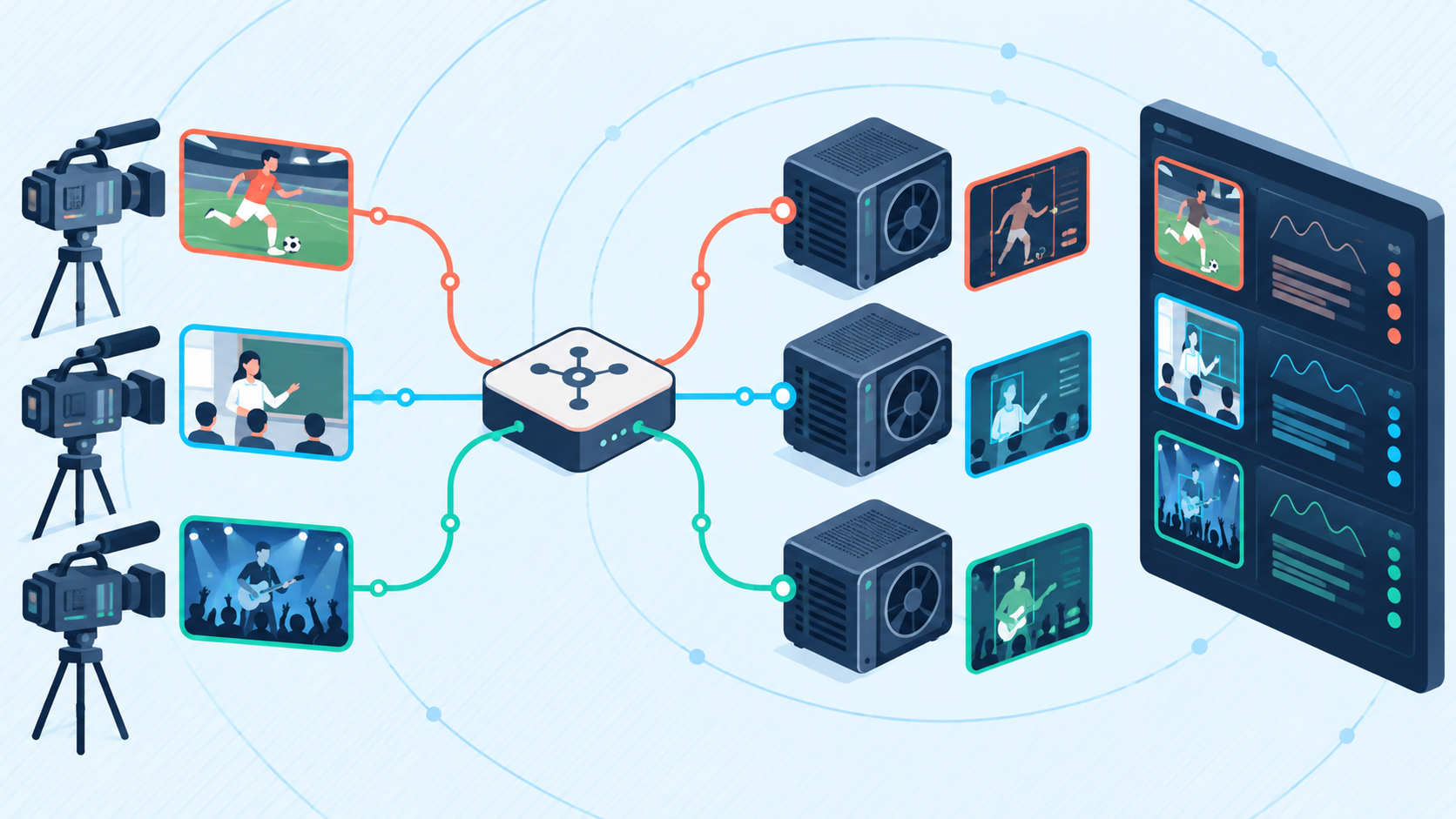
In the proposed Horus ISP architecture, cameras and initial detection stay at the customer site; the datacenter organizes events, evidence, permissions, apps and tenants. A complementary service would receive authorized tasks and return results linked to the original event. Cloud processing would be explicitly enabled.

The integration needs validation. PAIR’s LAN scope does not establish multi-tenant isolation, cross-site operation, high availability or SLAs. Additional quotas, traceability and access controls would be required. Critical alarms should retain reserved capacity and tested recovery.

Services and packages

  • Branch-level visual reports with a monthly allowance and human review.
  • Private event processing with agreed permissions and retention.
  • Reserved capacity for customers with demanding response times.
  • Cost-per-event assessment before expanding hardware.

Sources