
Background visual processing that turns images, events, and recordings into actionable information inside the Horus core and new revenue for the ISP.
Business opportunity
Cameras produce large volumes of images and video, while the ISP often monetizes connectivity alone. Processing every stream continuously raises costs and leaves valuable information outside operational workflows.
Horus service
Horus turns on-demand visual processing into a commercial service: it receives evidence, runs inference in the background, and transforms results into core-native events, states, timelines, clips, and metadata.
How it works
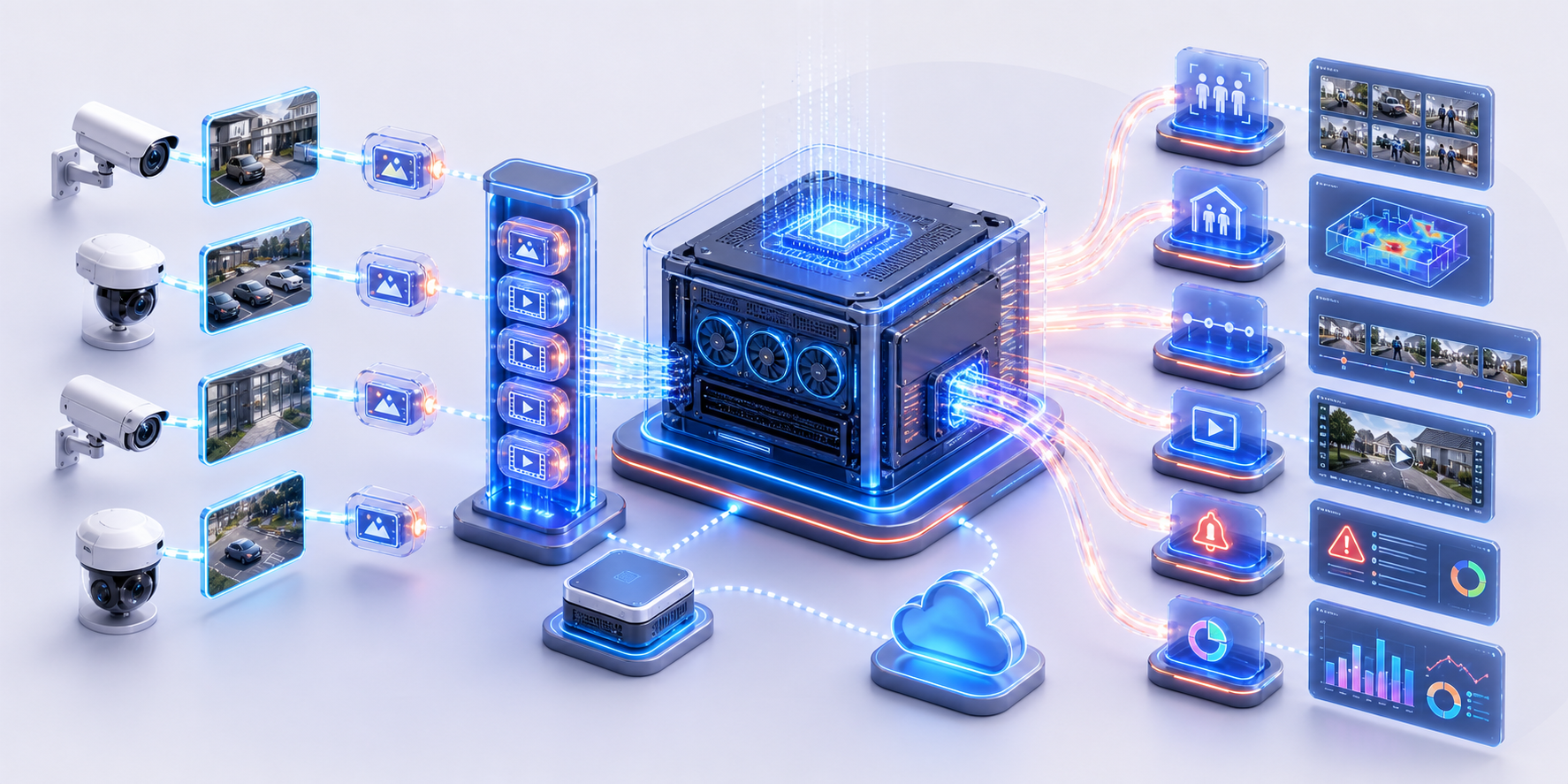
An event, request, or schedule creates an asynchronous job. Horus selects the relevant evidence, routes it to the right model, applies rules, and records structured results for notifications, search, dashboards, APIs, and automation.
Deployment model
Hybrid architecture with multi-tenant ingestion and control in Horus, job queues, and CPU/GPU workers deployable in the ISP datacenter, cloud, or edge nodes.
Key benefits
- New revenue by plan, camera, job, or consumption
- Lower cost than continuous video analysis
- Results integrated directly into the Horus core
- An extensible catalog of models and use cases
Ideal customers
From images to marketable information
Inference as a Service lets the ISP monetize compute capacity as well as connectivity. Instead of analyzing video 24/7, Horus processes only the evidence that matters and turns an image, event, or recording into information that the core can query, correlate, and use.
Three ways to activate the service
- Event-driven: a camera or NVR sends a snapshot and Horus validates whether a person, vehicle, or other relevant condition is present.
- Job-driven: a user or system requests image or recording analysis to find activity, generate clips, or build a timeline.
- Scheduled: Horus obtains periodic snapshots to determine occupancy, visual state, camera health, or scene changes.
Operating flow
- Horus receives evidence from cameras, NVRs, VMS platforms, storage, or APIs.
- The core identifies the customer, site, camera, plan, and retention policy.
- A queue decouples the request from processing and absorbs demand peaks.
- Workers select relevant evidence and execute the appropriate model.
- The rules engine interprets the result according to customer settings.
- Horus records events, states, timelines, clips, and usage metrics.
- Results become available to dashboards, search, notifications, webhooks, and other automation.
Monetizable capabilities
- Intelligent false-alarm filtering
- Search for people, vehicles, or objects in recordings
- Activity summaries, timelines, and automatic clips
- People counting, occupancy, queue, and parking analysis
- Visual state of doors, gates, containers, and assets
- Camera health: blur, obstruction, dirt, or position changes
- Visual inspection, industrial safety, and vertical-specific models
Monetization and margin control
The ISP can offer simple packages per camera or site and add premium capabilities. It can also charge by job volume, processed video hours, thousands of inferences, analysis tier, retention, or API access.
Horus meters processed images, selected frames, inferences, CPU/GPU seconds, storage, latency, and generated results. This enables usage limits, capacity planning, and cost and margin visibility for every service while customers receive a simple monthly price.
Integration with the Horus core
The output is not left as an isolated model response. Horus normalizes it into platform-native information: classified events, current states, time intervals, linked evidence, and metrics. Inference can then work with users, permissions, cameras, rules, notifications, audit, search, and multi-tenant operations.
When to choose OnDemand
The model is especially efficient when cameras already generate events, activity represents a small fraction of total time, and live viewing is not required. The camera initiates an outbound connection and the ISP shares processing capacity among many customers according to each plan's SLA.
Scale depends on event volume and bursts, not only on camera count. Horus governs reception, evidence retention, and inference independently, preventing an intensive configuration from consuming resources without control.
When operations require live video, continuous tracking, or minimum latency, permanent streaming remains the right model. The ISP can offer both modes as complementary services.